
 |
|---|
| image via X.com screenshots |
About three years ago, a religious discussion video of mine—on an unmonetized channel that hasn’t made a single cent to this day, and containing not a single second of music—was hit with a copyright strike. YouTube stated they would allow it to stay up “on the condition that they take all the revenue generated from the video.” I naturally appealed, and it was accepted. With the video having over 1 million views at the time, I don’t know how possible it is to look for any good intentions in this situation.
This mentality of extortion, hidden behind the guise of “art,” “copyright,” and “respect for labor” by giant corporations managing billions of dollars in profits, has always terrified me. Fortunately, since I had no expectation of generating income online in my case, I had the chance to observe this incident from a bit of a distance.
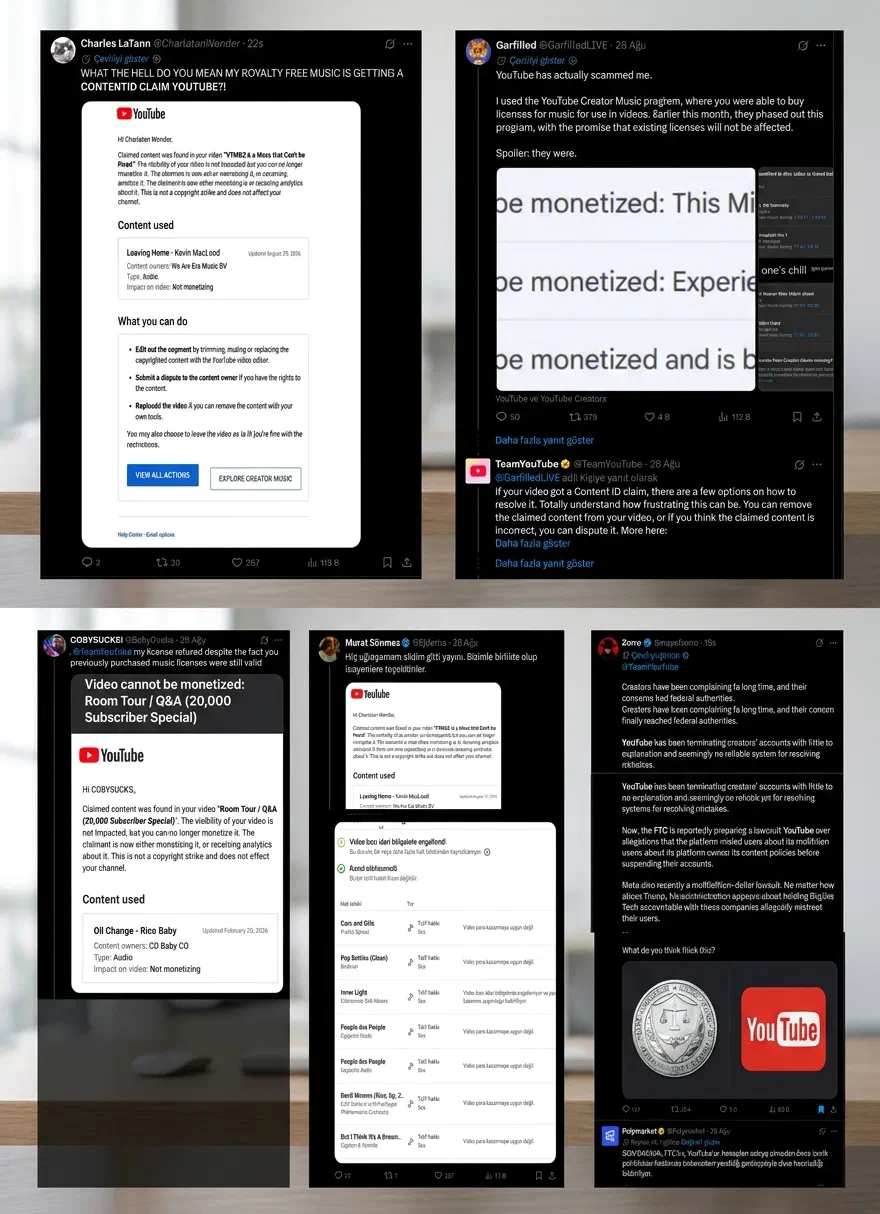
Lately, however, I’ve started seeing posts about numerous channels being shut down without warning due to Content ID violations or vague policy changes on YouTube. The deletion of people’s decades of hard work without a single warning has rightfully brought users to the point of rebellion. Some of the loud objections that trend on social media get reviewed and resolved by the “YouTube Team”—but what about those who can’t make their voices heard?
I don’t think it would be wrong to assume that the main culprit behind the recent surge in these incidents is “artificial intelligence.” Because it’s no longer possible to moderate these platforms—which I call social media cartels—with human labor, given the billions of pieces of content uploaded every day. Considering the attitude these cartels adopt during the development of AI, an average human intellect is more than enough to connect the dots between the systemic structure and the grievances being experienced.
Here are just a few of the outcries I came across with a simple search on X (formerly Twitter):
- GarfilledLIVE’s Post
- CharlatanWonder’s Post
- Wayofzorro’s Share
- Grundstromleo’s Experience
- Polymarket’s Situation
- Joe2ShiestyLit’s Post
- ShredhedG’s Reaction
- J4mlab’s Post
- SobyCucks’ Post
We don’t know for sure whether this situation is caused by AI, the corporations themselves, or YouTube’s unknown internal dynamics. However, the allegation that YouTube—which is banned in China—forced a content creator named Ruhi Çenet with 18 million subscribers to delete his video really bothered me. The fact that the reason cited for the deletion was his coverage of the oppression of Uyghurs in East Turkestan makes the situation even more grave. In my opinion, for tech giants like Google, Nvidia, X, Meta, Apple, and Microsoft, the priority is always money. Let’s say we’ve gotten used to countries requesting channel closures or video deletions; and let’s even interpret corporations wanting to stay out of trouble in political affairs as a “corporate reflex” to some extent… But what is the sin of independent content creators who quietly spend their days and hours working on their craft?
An Alternative Path: Holding Your Own Keys
In light of all these developments, I believe it is time for content creators to seriously think and take action. The first and most solid solution that comes to my mind is the self-hosting option.
The initial setup phase might require challenging processes and seem daunting, but the digital independence it provides in the long run will definitely bring a smile to your face. Of course, as an individual, it’s hardly possible to offer an infrastructure as flawless as the companies that shape the tech world with their massive data centers and nearly unlimited bandwidth. In many cases, you won’t be able to stream 4K or 8K video. Perhaps you won’t be able to set up services with your dream interface on day one, or develop flawless native apps for every platform. But ultimately, you will have a system where the keys belong entirely to you, which you can turn on and off whenever you want, and where you set the rules.
Gathering people into your own sphere of influence and tearing them away from the platforms they are used to is a difficult process. Because people make their voices heard more easily in crowded environments, and they love crowds. I am aware of all of this.
Right at this point, a fantastic solution steps in to eliminate the fear of “being left alone on your own digital island”: Decentralized networks and the Fediverse. Not only can you set up your own server, but you can also host platforms like Mastodon (an X/Twitter alternative) or PeerTube (a YouTube alternative) on your own hardware. Thanks to these systems, you become the absolute boss of your data while continuing to interact with a massive, interconnected network of millions of users through open protocols like ActivityPub. In other words, you step out of the walled gardens of big tech companies and into an ecosystem that is both free—where you set the rules—and just as crowded.
Naturally, this independence brings its own challenges. But isn’t that the rule of life? Responsibilities breed problems, and we grow to the extent that we solve these problems. This growth brings new powers and new responsibilities with it. In other words; what doesn’t kill us, makes us stronger.
Liberation from Digital Slavery
The positive aspects of taking on our own responsibility and breaking free from this ‘digital slavery’ are countless. AI, which has become a nuisance for content creators, can actually turn into a perfect assistant for developing our own services, websites, or designs.
With almost zero coding and design knowledge, I also brought this site to life at home using a Raspberry Pi with the help of AI. Today, most of us have 24/7 uninterrupted broadband internet in our homes. Building your own server at very affordable costs using old computers or mini-PCs like a Raspberry Pi is no longer just a dream.
The vast majority of people now consume content on their smartphones. You might not be able to stream in 4K from your own server, but starting with 720p is not a bad idea at all. Besides, there is practically no infrastructure bottleneck for photo, audio, and text-based content.
Conclusion
It might not be realistic to completely turn our backs on big tech giants and social media cartels in a single day. However, we can start the change gradually with strategic steps spread over the long term. We can stop treating our social media presence as a “headquarters” and instead use it as a “signboard” that guides people step-by-step to the services and websites we have built and where we set the rules.
We must build safe harbors where algorithms, AI, or obscure corporate policies cannot wipe out our hard work overnight. As people gather on independent platforms like the Fediverse over time, it is absolutely possible to build that strong, organic community that truly belongs to you—based on quality rather than quantity.
Remember; unless you build your own house in the digital world, you are always condemned to remain a tenant on someone else’s land and bow to their rules. It’s time to become the boss of your own data and labor.