
Will Living Without Robots Feel Strange One Day Too?
 |
|---|
| image via openai |
Sometimes technology advances so slowly that we don’t notice the change. Then one day, when we look back, we realize our lives have completely changed. I believe artificial intelligence and robot technologies are going through exactly this kind of process.
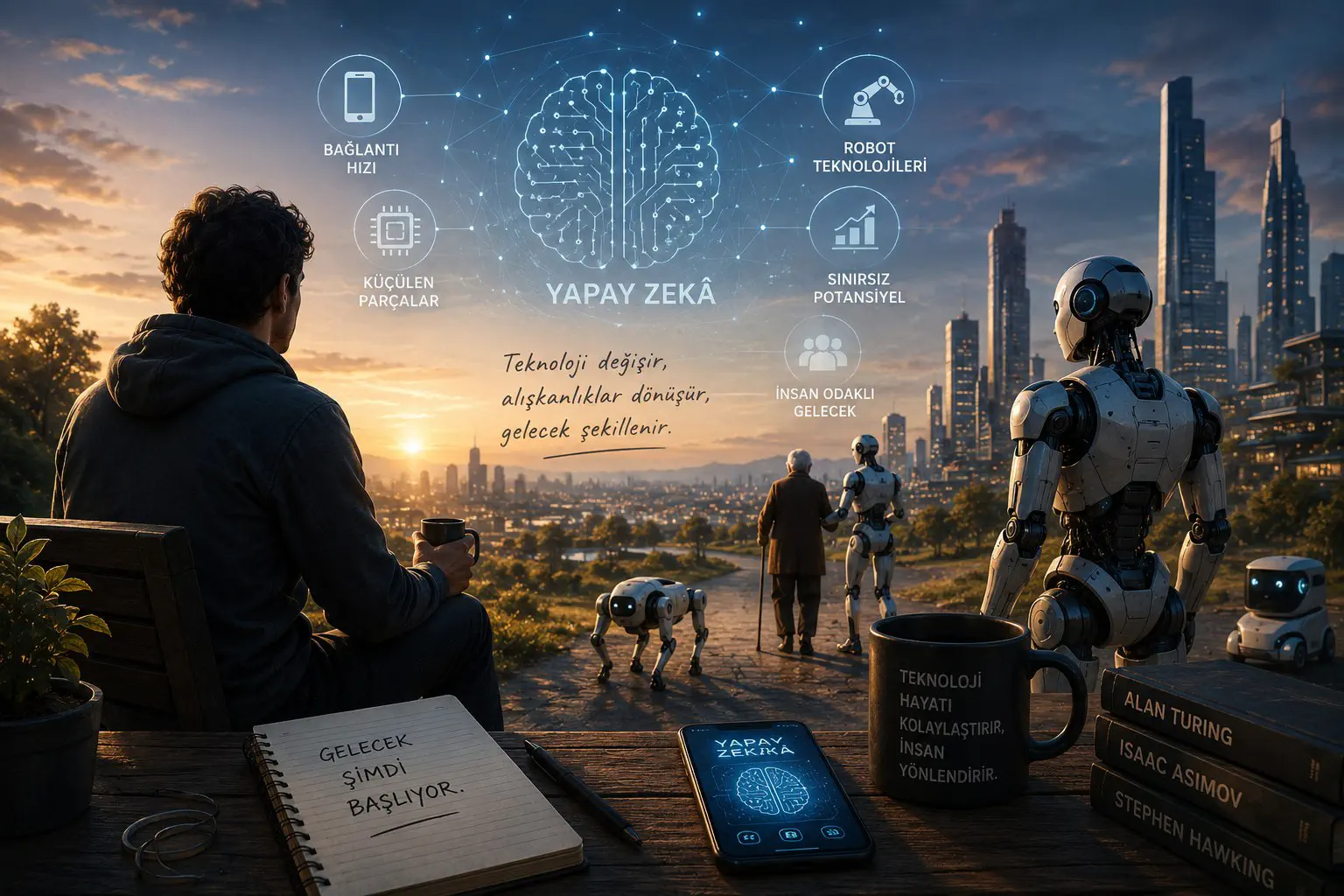
Today, many people think of artificial intelligence merely as software. Chatbots that answer our questions, systems that generate images, or recommendation algorithms… But in my opinion, the true impact of artificial intelligence will emerge when it merges with robot technologies. Because when the ability to think is combined with physical movement, technology will no longer be confined to screens; it will become a direct part of daily life.
We have experienced a similar transformation before. There was a time when mobile phones were devices used only for making calls. The internet was slow, processors were weak, and cameras were bad. However, as connection speeds increased, components shrank, and software began to develop, phones started to transform as well. Today, smartphones have become an inseparable part of our lives, from communication to banking, from photography to entertainment.
Artificial Intelligence and Robots: The Silent Partners of the Future
While thinking about this situation, we should give a nod to the famous robotics expert Hans Moravec. His famous “Moravec’s Paradox” tells us something very interesting: Solving highly complex mathematical problems is child’s play for computers, but walking across a room or gently holding a glass, like a baby does, is impossibly difficult for them.
Here is what is exciting today: We are now overcoming this paradox. Just as pioneers like Rodney Brooks imagined years ago, robots are no longer just hunks of metal waiting for commands; they are turning into entities that learn about their surroundings just like us. This is exactly what NVIDIA’s CEO Jensen Huang calls “Physical AI”. That is, intelligences that not only “think” but also understand the laws of physics and move.
I think we will see the same process for artificial intelligence and robots in the coming years.
We are still in the early stages right now. Robots often seem slow, expensive, and have limited capabilities. But computers were like that in the past, too. Think of the space a computer occupied in the 1970s; today we carry the same processing power in our pockets. The history of technology shows us this: If something becomes smaller, cheaper, and more accessible, it eventually turns into a natural part of daily life.
There were also scientists who put forward important ideas on this subject in the past. Alan Turing was discussing the possibility of machines thinking decades ago. Isaac Asimov, on the other hand, imagined the place of robots in human life and put forth the famous “Laws of Robotics”. At that time, these seemed like science fiction, but today many technology companies are actually pursuing these ideas.
It is particularly noteworthy that figures like Elon Musk have invested in humanoid robot projects in recent years. Not only car manufacturing companies, but also technology companies that develop robots are emerging. Because it is believed that the future will be shaped not only by software, but by the merging of software with the physical world.
Seeing assistant robots in homes after a certain point no longer seems like a distant possibility to me. Perhaps they will support the elderly, perhaps they will facilitate daily chores, or perhaps they will create massive changes in the fields of education and healthcare. Just as a life without a phone feels incomplete to many people today, living without AI-supported systems might feel difficult in the future.
Of course, the important thing here is not just technology. How humanity will manage this transformation is also a big question mark. Issues such as the ethical boundaries of artificial intelligence, its impact on business life, and people’s dependence on technology seem poised to be discussed more in the coming years. Even Stephen Hawking had said that artificial intelligence carries both great opportunities and serious risks for humanity.
Still, I don’t think technology is something to be completely feared. Throughout human history, every major technological transformation has initially caused anxiety. Electricity, the internet, automobiles… They were all met with fear at one point. But when used correctly, they made life easier.
Perhaps right now, we are the generation witnessing the ordinary technologies of the future for the first time. Just as not everyone could predict how much the internet would grow in the past, we cannot fully foresee the future impact of artificial intelligence and robots today.
But I have a strong feeling inside: In the next 10-20 years, artificial intelligence and robots will become indispensable parts of our lives. And probably, when that day comes, we will look back at today’s world and think it was quite primitive. Perhaps, just as we don’t go out without our cell phones today, we will reach a point where we won’t go out without our robots.
Note: Artificial intelligence also helped in the preparation of this article.