
Notes from Artificial Intelligence News - 11
Notes I took from the artificial intelligence news that caught my eye between March 11 and March 15.
 |
|---|
| image via microsoft |
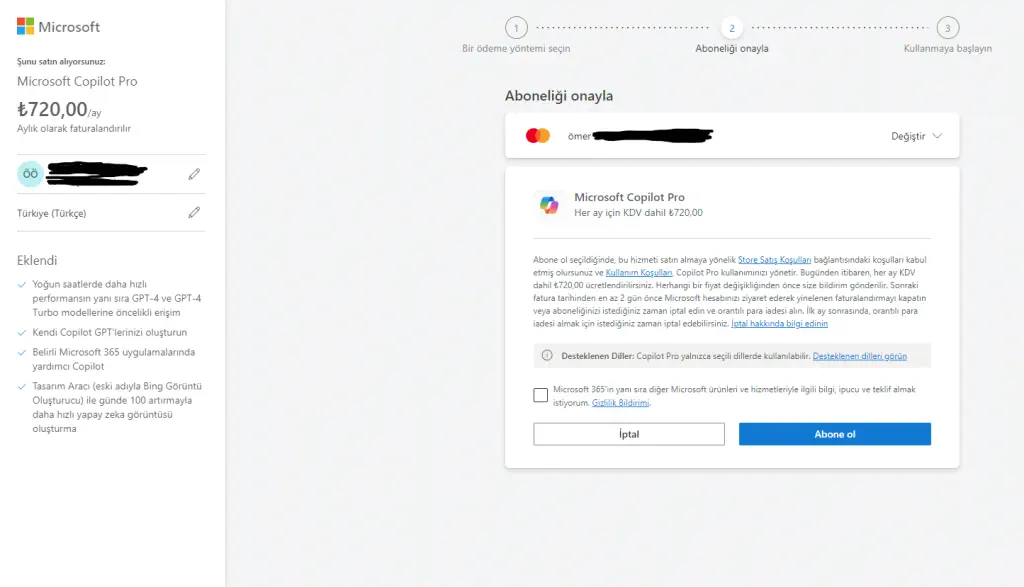
Microsoft made Microsoft Copilot Pro available for use worldwide. Offered at a price of $20 per month in the US and 720 TL in Turkey, the Copilot Pro artificial intelligence tool can be used integrated with other applications like Office 365. Some of the features offered are:
- Gain priority access to GPT-4 and GPT-4 Turbo for faster performance, including during peak hours.
- Utilize Copilot in select Microsoft 365 Apps to draft documents, summarize emails, and format presentations.
- Create images in Designer (formerly Bing Image Creator) with 100 boosts per day.
Elon Musk announced that the Grok artificial intelligence will be open-sourced. The AI chatbot, which Premium+ members on Twitter can utilize, had become an application largely forgotten by many for a long time after its launch last year. There seems to be little chance of competition for the chatbot positioned as a rival to Google’s Gemini and OpenAI’s GPT-4. We will see together how open-source AI will make a difference.
This week, @xAI will open source Grok— Elon Musk (@elonmusk) March 11, 2024
- The ai.com domain name, whose ownership remains a mystery, has now been redirected to gemini.google.com . I wonder who the owner of the domain is, which was previously known to redirect to ChatGPT. The final owner of the name, registered in 1993, might be quite lucky.
- It is said that OpenAI’s text-to-video artificial intelligence application Sora will be made available for public use towards the end of this year. The phrase ‘What is coming is coming!’ perfectly suits this technology. Because, as everyone anticipates, we are very close to the days when one era closes and another begins.
- This news is of the kind that perfectly explains what awaits us. The Figure AI company, which produces humanoid robots and collaborated with OpenAI last month, released a new video. The first fruits of this collaboration might be magnificent to some and scary to others. Because the video of the Figure 01 robot, which has real-time image recognition and human-like speaking capabilities (VLM – Vision-Language-Model), is unbelievable. The company states in a post published on its Twitter account that the robot can have full-scale conversations with humans. Furthermore, it is specifically stated that there is no acceleration in the robot’s movements in the video and that it is broadcast in real-time. For those who understand…
- The Artificial Intelligence Act of the European Parliament and Council, which I reported on in recent months and which aims to ensure the safe and ethical development and use of artificial intelligence (AI) in Europe, was approved on December 6, 2023. I am adding the press
release
(a bit long) from the official website of the European Parliament below.
- The main objectives of the agreement are: - Protecting fundamental rights, democracy, and environmental sustainability: The act bans applications such as certain biometric categorization systems that threaten human rights, and AI that manipulates behavior or exploits vulnerabilities.
- Fostering innovation and boosting investment: The law aims to promote the development and uptake of safe and trustworthy AI by both private and public actors in the EU’s single market.
- Making the EU a global leader: The law aims to establish a global standard for AI use that recognizes its potential while mitigating its risks and impacts.
- The key elements of the law are:
- Risk-based classification of AI systems: Systems will be divided into four categories based on their potential risks and level of impact:
- Acceptable risk: Low-risk systems that do not require any specific measures.
- Low risk: Systems requiring basic risk management measures.
- High risk: Systems requiring comprehensive risk assessment and conformity assessment.
- Very high risk: Prohibited applications or systems allowed only in extraordinary exceptional circumstances.
- Data requirements: For high-risk systems, developers will need to demonstrate that they use representative, diverse, and unbiased datasets.
- Transparency and accountability: Developers must ensure transparency and traceability for all AI systems, including high-risk ones.
- Compliance and oversight: The European Commission will have the authority to oversee the compliance of AI systems and enforce sanctions.
- The AI Act is expected to have a significant impact on the EU’s digital future. By providing a framework for the development and use of AI in Europe, the law aims to consolidate the EU’s global leadership in this field and protect the rights of European citizens.