
Notes from Artificial Intelligence News – 5
Notes I took from the artificial intelligence news that caught my eye between February 6 and February 15.
- I am starting this section with a very interesting fraud news . In fact, it might be the first of its kind. The fraud involved a digitally recreated version of the chief financial officer (CFO) and other employees of a Hong Kong company in a video conference call instructing an employee to transfer money. There is no information yet about the scammer who managed to get 25 million dollars transferred to themselves via DeepFake. What is certain for now is that the scammers managed to convincingly copy the appearances and voices of the targeted individuals using publicly available video and audio recordings. Hong Kong police have not provided information about the defrauded company either. But judging by the amount, it is definitely one of the biggest.
- China launched the ‘world’s first’ artificial intelligence satellite. The hyper-satellite is thought to be an integrated sensing network satellite containing a sixth-generation ‘brain system’. The satellite is said to have a smart algorithm that combines and analyzes different types of data. I hope it doesn’t get out of control.
China launched the ‘world’s first’ commercial artificial intelligence hyper-satellite Xingshidai-18 into orbit on February 3. While there is not much information about the satellite, Xingshidai-18 is expected to process and analyze data internally. #AI #China #satellite pic.twitter.com/cTSpT1PEVk — Metin Yasir Akpınar (@MtnAKPINAR) February 5, 2024
- A PhD student, a robotics student, and a 21-year-old computer science student used artificial intelligence to reveal the text on an ancient parchment heavily damaged by the eruption of Mount Vesuvius. And they managed to solve a nearly 2000-year-old secret.
Ten months ago, we launched the Vesuvius Challenge to solve the ancient problem of the Herculaneum Papyri, a library of scrolls that were flash-fried by the eruption of Mount Vesuvius in 79 AD.
Today we are overjoyed to announce that our crazy project has succeeded. After 2000… pic.twitter.com/fihs9ADb48 — Nat Friedman (@natfriedman) February 5, 2024
- Last year, AI-generated images of the Pope and Trump caused a stir. Meta will start labeling AI-generated images on Instagram and Facebook to prevent such incidents. Do not be surprised when you see an ‘AI Generated’ label on some images soon.
- The change that has been rumored for the past few weeks has happened, and ‘ Bard ’ has now become ‘ Gemini ’. Google’s fresh artificial intelligence assistant changed its name before completing its first year. The release update notes that took place on February 8 have also been published .
- Among the prominent features from the release notes are;
- Visual simplicity, improvements have been made to the user interface to facilitate readability and navigation.
- All Gemini users in supported countries and languages have access to Google’s best family of AI models.
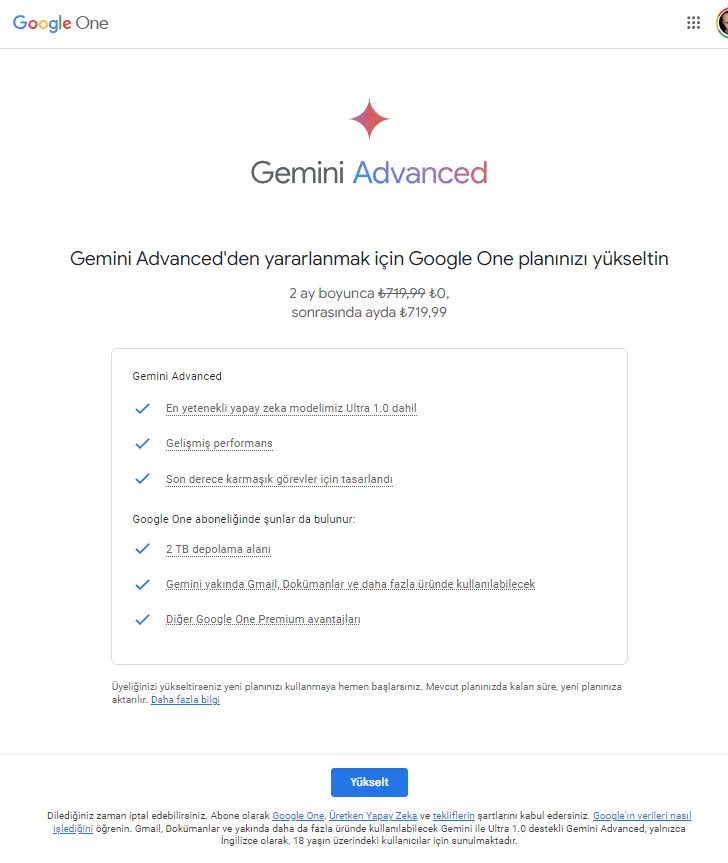
- If you want to be one of the first to access Google’s latest advancements in AI, you are in the right place. With our Ultra 1.0 model, Gemini Advanced is far more capable at highly complex tasks like coding, logical reasoning, following nuanced instructions, and creative collaboration. In the coming months, Gemini Advanced will continue to expand with new and exclusive features, including increased context length, expanded multimodal capabilities, and even better coding features, as well as the ability to upload and more deeply analyze files, documents, data, and other content. Gemini Advanced is a paid plan available in at least 150 countries and territories . The Ultra 1.0 model is currently only available and optimized for English but can respond to queries in other languages that Gemini is available in. Learn more
- Since Gemini integrates with Google apps like Gmail, Maps, and YouTube, it makes it easier to get things done on your phone. You can interact by typing, talking, or adding images.
- The Gemini app for Android will roll out on select devices in English in the US. In the coming days, it will be available globally in English except for the UK, Switzerland, and European Economic Area countries and their associated territories, as well as in Japanese and Korean. More countries and languages will be added soon.
 |
|---|
| image via google |
- According to The Wall Street Journal’s news , OpenAI CEO Sam Altman wants to tackle the global semiconductor (AI chips) industry with trillions of dollars in investment. Altman said that AI chip limitations are hindering OpenAI’s growth, and because this project would increase chip-building capacity globally, he has held talks with investors, including the United Arab Emirates government, according to WSJournal. A figure of 5 to 7 trillion dollars is being discussed, but there is no source confirming the figure. If you ask me, whoever made up these figures does not know how to count.
we believe the world needs more ai infrastructure–fab capacity, energy, datacenters, etc–than people are currently planning to build.
building massive-scale ai infrastructure, and a resilient supply chain, is crucial to economic competitiveness.
openai will try to help!— Sam Altman (@sama) February 7, 2024
- Nvidia introduced the ‘Personalized AI Chatbot with Chat With RTX’ for 30 and 40 series cards. The application, which locally supports Mistral or Llama 2 language models, is available for free download . For your personal artificial intelligence chatbot, which you can install on your computer with a massive 35 GB zip file, Windows 11, Min 16 GB RAM, Nvidia’s min 535.11 version driver, and of course a 3000 or 4000 series RTX graphics card are required. I haven’t had the chance to try it yet because at a speed of 300 kb, it looks like it will take more than a day. I guess the interest in Nvidia Chat with RTX, which only shares a download link from the US server, is very high. It is very good that generative AI like Automatic1111/Stable Diffusion is coming to personal computers, this time text based. I can’t wait to try it.
- It is claimed that OpenAI might be developing a search engine to rival Google. The Information reports that OpenAI is working on a “web search product,” citing someone familiar with the company’s plans. According to the source, this service will be partly powered by Microsoft’s Bing. I think artificial intelligences like ChatGPT and Gemini can already be called search engines at a 50% level. The remaining 50% is to scan the www in real-time and bring it intelligently before the users.
 |
|---|
| image via companiesmarketcap.com screenshot |
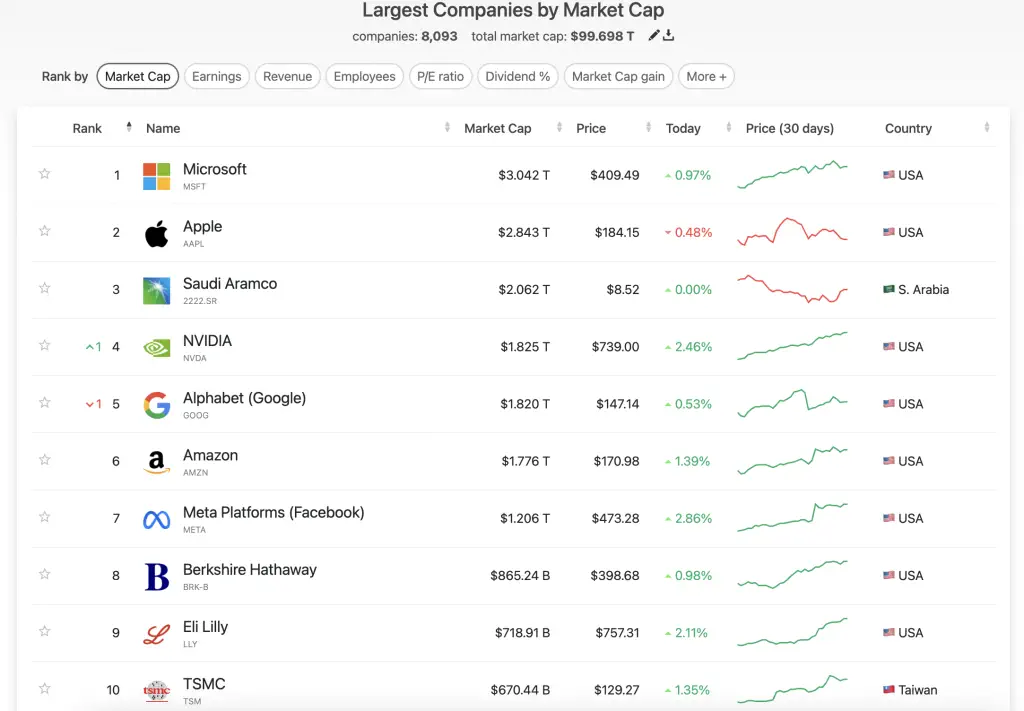
- It would be appropriate to say that Nvidia stock values have taken off with the effect of artificial intelligence. As I write this news on February 15, it has surpassed Facebook, Google, and Amazon and risen to 4th place. It was fifth just yesterday. If it goes on like this, it seems to me that we can expect Nvidia to make history before the end of this year. Of course, there is also the possibility of artificial intelligence bursting just like the dot com bubble before. It is very difficult to predict what time will show.
- OpenAI is bringing a memory feature to ChatGPT. They say that the memory feature will save us from constantly repeating the same things, and this way it will give better answers with what it remembers about us. Depending on choice, some options of this feature can be turned off or it can be completely disabled. It sounds good, but it inevitably raises question marks about privacy and what might happen to us in the future…
- The US patent office has finalized its decision that artificial intelligence cannot be a patent holder. However, by saying ‘the use of an artificial intelligence system by a natural person does not preclude the natural person from qualifying as an inventor.’, it has also decided that the people using artificial intelligence will be the true owners of the patent. But it has requested that it be disclosed if help from artificial intelligence was received while making the invention. A heads up for inventors…
 |
|---|
| image via google gemini |
- Google announced the Gemini 1.5 version. Trained with 10 times more data than the previous generation (Gemini 1.0), a dataset consisting of 1.5 trillion tokens was used for Gemini 1.5. Gemini 1.5 will be used in Google products like Google Translate, Google Search, and Google Assistant. For Gemini 1.5, it is said that it will help Google Translate make more accurate and fluent translations, Google Search better understand queries and provide more relevant results, and Google Assistant better understand users’ requests and respond more naturally.