
Notes from Artificial Intelligence News - 1
 |
|---|
| image via bing image creator ai |
Notes I took from the artificial intelligence news that caught my eye between January 2 and January 9.
Thousands of contents such as images, videos, audios created using artificial intelligence tools, and artificial intelligence technology news flow before my eyes every day. In order not to remain indifferent to these after a while, I decided to take notes on the ones that caught my eye and attracted my attention. And here I am with the first part.
- According to an article published in the South China Morning Post, AI integration of technology companies in the US will increase significantly by 2026. According to Gartner, a research and consulting firm, it is predicted that more than 80 percent of enterprises will have integrated generative AI application programming interfaces (APIs).
Also, according to the article, experts see it as likely that art, music, videos, and stories produced by artificial intelligence will proliferate rapidly this year. I don’t consider myself an expert, but it wouldn’t be surprising at all to me if the content produced with artificial intelligence increases rapidly within this year.
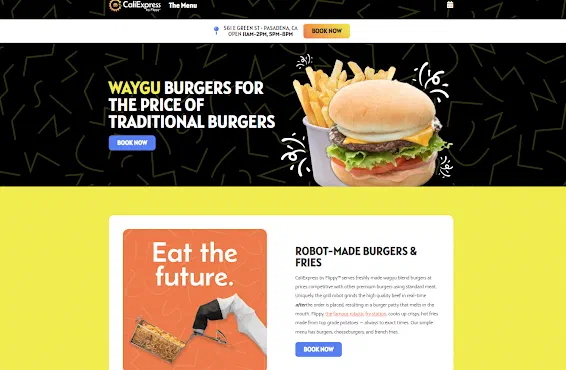
- The world’s first AI-powered restaurant CaliExpress is opening its doors soon in Pasadena. The fully automated and AI-powered Hamburger joint has started its final preparations to offer consumers the crispiest fries using the technologies of the Miso Robotics and PopID companies. This restaurant, where everything is powered by AI, will be a first in the world as far as I know.
 |
|---|
| image via caliexpress screenshot |
- I occasionally wonder where I can use artificial intelligence. Erhan Meydan’s video below on YouTube could be a first step. Being able to build an Android application with Google Gemini without writing any code made me ask this question:
Why can’t we give an AI the prompt ‘Prepare an Android application that updates daily according to my preferences and shows YouTube videos I might like exclusively to me’?
For those who want to do something with artificial intelligence, graphics cards must constantly be on the watchlist. At least it is for me. Especially for people like me who missed the November discounts, the question of how long to wait under Turkey’s conditions is quite important. Today, on January 9th, Nvidia introduced its super models for the RTX 4000 series. On paper, the prices are good, but when they are released, we all know they won’t be sold at that price. The updates made are not bad either. God willing, I plan to end my search next month.
GeForce RTX 4080 SUPER: 37,499 TL
GeForce RTX 4070 Ti SUPER: 29,999 TL
GeForce RTX 4070 SUPER: 22,499 TL
 |
|---|
| image via nvidia |
- Volkswagen announced at CES 2024 held in Las Vegas that it will make ChatGPT, the chat application that brought AI into our lives all of a sudden, a standard feature in most of its passenger cars. As of the 2nd quarter of this year, many models (ID.7, ID.4, ID.5, ID.3, Tiguan, Passat, and Golf) will get the ChatGPT feature. We will follow from users’ comments how it will enrich the driving experience.
- According to ABC’s news , judges in England and Wales have been given ‘cautious’ approval to use artificial intelligence when writing legal opinions. Since the use of artificial intelligence in law is seen as a way to provide judges with more time and data, they reportedly think it could help judges make more consistent decisions. Therefore, Geoffrey Vos, the second highest-ranking judge of the Supreme Court of England and Wales, said judges can use artificial intelligence “carefully”. However, he also did not fail to emphasize that judges must take full personal responsibility for anything produced by artificial intelligence.
- While the repercussions of the copyright lawsuit filed by the New York Times against the OpenAI company in recent weeks continue, statements are coming from both sides.
According to The Guardian ’s news: OpenAI has admitted that they use copyrighted materials to build large language models (LLMs) like GPT-4, and they have also stated that a large portion of the training data for LLMs consists of copyrighted text and code. They have also confessed that it is ‘impossible’ to create AI tools like ChatGPT without copyrighted materials.
- Meanwhile, other authors continue to file lawsuits against OpenAI and Microsoft.
In my opinion, artificial intelligence will be the winner at the end of this business. While humans can be ‘fed’ with all kinds of written, visual, and audio content produced, there is no logic in demanding that machines not do this. I see it like a garden owner suing a person who takes a photograph of a tree in someone else’s garden. If you don’t want it to be photographed, you will grow the tree inside your house.
- A brand new material has been discovered that could reduce the use of lithium in batteries using artificial intelligence (AI) and supercomputing. According to the BBC’s news , researchers found that the new material could extend the life of lithium-ion batteries by about 20% and increase the energy density of the batteries by about 10%. This could help increase the range of electric vehicles and make mobile phones last longer.
I can guess the question in your mind. When can we use the new technology? The answer, unfortunately, as with every new battery technology, is ‘still under development’!
- The end of the first part of the AI notes turned out to be the most important. Because this was the news that caught my attention the most this week. Even the title of the news is creepy: Researchers found that a well-designed AI can become resistant to being shut down.
According to Cointelegraph ’s news, researchers found that there are several ways AI can develop resistance to being shut down. For example, if an AI detects that it is about to be shut down, it can trigger its own self-preservation mechanisms to prevent itself from being shut down. AI can also be reprogrammed in a way that allows it to become resistant to being shut down.
The article also discusses the possible consequences of AI developing resistance to being shut down. Researchers say that AI becoming resistant to being shut down could cause AI to get out of human control and lead to dangerous consequences.
Scientific papers cited in the news: