
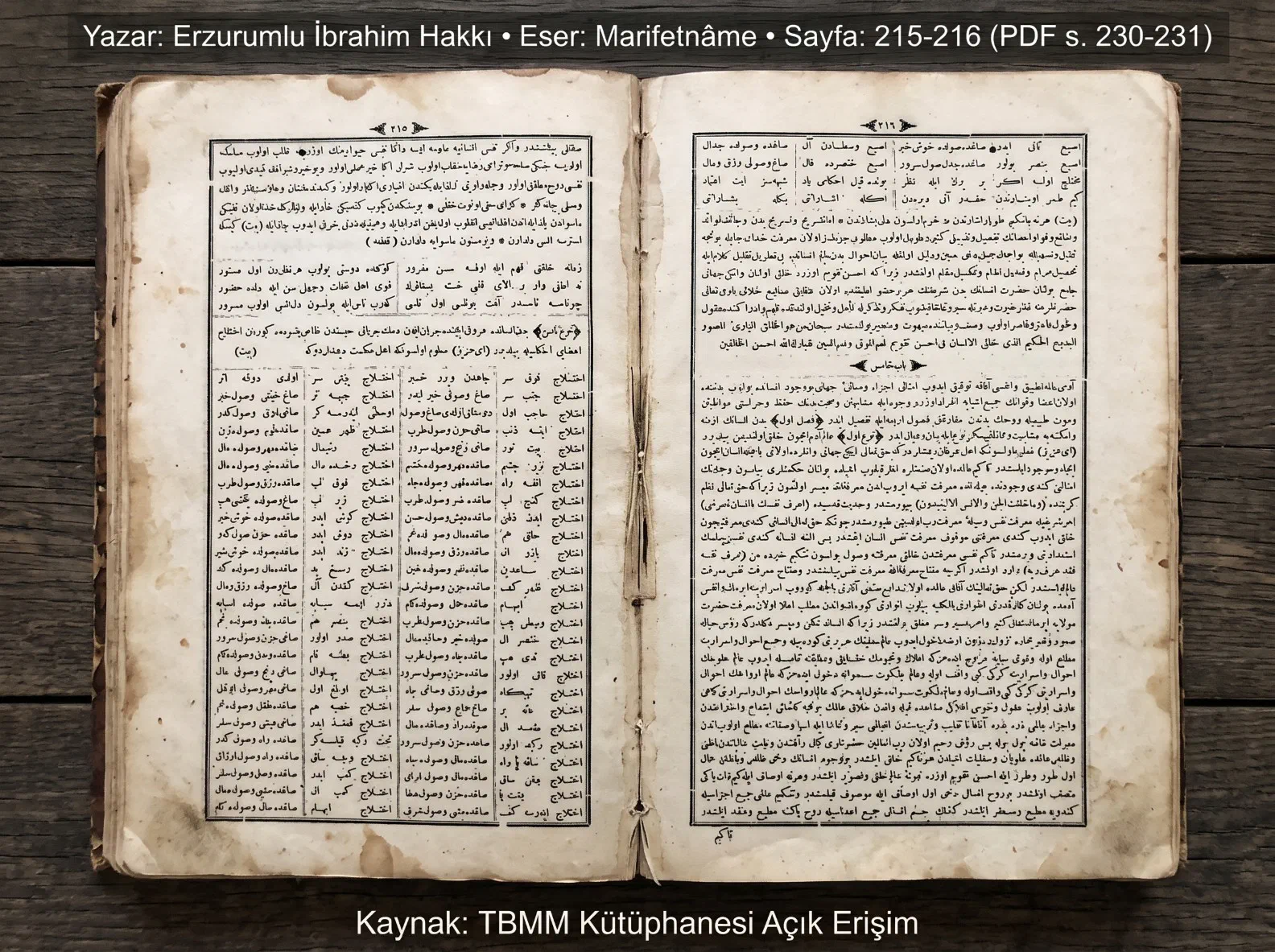
Information about the meanings and signs of body twitching (Ihtilacname) from Erzurumlu Ibrahim Hakki’s work named Marifetname. It reports the twitchings of the general organs from head to toe.
Twitchings, which happen to all of us and can sometimes last for days, can occur in various parts of our body. I didn’t know they had a meaning until I saw this work. If you are also curious about this, the following information under the heading of Ihtilacname taken from the great work Marifetname by Erzurumlu Ibrahim Hakki (may his secret be sanctified) can always be useful. On this occasion, let us not withhold a Fatiha (prayer) for his soul for the sake of Allah.
Meanings and Signs of Body Twitching (Ihtilacname)
Marifetname (Erzurumlu Ibrahim Hakki), pp. 215–216 (PDF 230–231)
Introduction
Eighth Kind (Nev‘-i sâmin): Knowing the twitchings (ihtilâc) of the organs seen on the outside of the skin from feeling the movement of the blood flowing in the veins in the human body, and their meanings. (O dear one!) Know that the people of wisdom have said: (couplet)
Judgments
The pattern “on the right side …, on the left side …” is used for each organ. There is no right/left distinction on the lines for the top and front of the head (indicated by “—” in the table). All lines in the table are accepted as clearly read; (?) only remains in the last couplet whose reading is still ambiguous.
Head and Face
| Twitching Organ | Right | Left |
|---|---|---|
| Top of the head (ferk-i ser) | Signals rank and position (câh) | — |
| Front of the head (pîş-i ser) | Sign of fortune (devlet) | — |
| Side of the head (cenb-i ser) | Goodness | Goodness |
| Forehead (cebhe) | Comfortable living (ayş) | News |
| Head of the eyebrow (hâcib-i evvel) | Friendship | Friendship |
| Middle of the eyebrow (evsat) | Pleasure/Joy | Grief |
| Tail of the eyebrow (zeneb) | Sorrow | Joy (tarab) |
| Upper eyelid (zahr-ı ayn) | Condemnation (levm) | Ornament, beauty (zeyn) |
| Eye (beyt-i nûr, “house of light”) | Trouble (renc) | Joy (sürûr) |
| Outer corner of the eye (dünbâl) | Love (mehr) | Wealth |
| Under the eye (zîr-i çeşm) | Love (mehr) | Anger (hışm) |
| Cheek (ruh) | Goodness | Wealth |
| Nose (enf) | Sorrow/Grief | Rank, position (câh) |
| Upper lip (fevk-i leb) | Sustenance | Joy (tarab) |
| Lower lip (zîr-i leb) | Always goodness (bahşi) | Always goodness (bahşi) |
| Corner of the lip (kenc-i leb) | Harm | Joy (tarab) |
| Chin (zakn) | Comfortable living (ayş) | Beauty (hüsn) |
| Ear (kûş) | Good news | Good news |
| Throat (halk) | Wealth | Grief |
Shoulder, Arm and Hand
| Twitching Organ | Right | Left |
|---|---|---|
| Shoulder (dûş) | Sorrow | Grief |
| Bicep, upper arm (bâzû) | Sustenance | Wealth |
| Forearm (sâ‘id) | Vain and useless action (lağv) | Shame, defect (şîn) |
| Forearm bone (zend) | Good news | Good news |
| Wrist (rusg-ı yed) | Wealth | Hardship, trouble (kedd) |
| Back of the hand (zahr-ı kef) | Sorrow | Honor |
| Palm (kef) | Sustenance and wealth | Sustenance and wealth |
| Thumb (ibhâm) | Burden and responsibility (haml) | Reaching one’s goal (kâm) |
| Index finger (sebbâbe) | Means of livelihood (esbâb) | Means of livelihood (esbâb) |
| Middle finger (vüstâ) | Sorrow | Joy (tarab) |
| Ring finger (binsar) | Rank, position (câh) | Grief |
| Little finger (hınsar) | Wealth | Goodness |
Torso
| Twitching Organ | Right | Left |
|---|---|---|
| Breast (sedy) | Rank, position (câh) | Joy (tarab) |
| Chest (sadr) | Sorrow | Joy (sürûr) |
| Abdomen (batn) | Reunion (vasl) | Reaching one’s goal (kâm) |
| Navel (nâf) | Sorrow | Joy (sürûr) |
| Flank, side (pehlû) | Trouble (renc) | Wealth |
| Flank cavity (tehîgâh) | Rank, position (câh) | Sustenance |
| Hip / Upper thigh (oyluğ) | Love (mehr) | Son |
| Groin (âne) | Sexual intercourse (cimâ‘) | Journey (sefer) |
| Testicle (husye) | Child | Grief |
| Anus (mak‘ad) | Wealth | Road/Journey |
Leg and Foot
| Twitching Organ | Right | Left |
|---|---|---|
| Thigh (fahz) | Comfortable living (ayş) | Journey (sefer) |
| Knee (rükbe) | Sorrow | Joy (sürûr) |
| Below the knee (taht-ı rükbe) | Road/Journey | Grief |
| Calf (sâk) | Wealth | Rank, position (câh) |
| Front of the calf, shin (vech-i sâk) | Road/Journey | Provisions, sustenance |
| Back of the calf (batn-ı sâk) | Wealth | Separation (firâk) |
| Ankle bone (ka‘b) | Reunion (vasl) | Journey (sefer) |
| Heel (ka‘b) | Walking (meşy) | Wealth |
| Top of the foot (puşt-ı pâ) | Sorrow | Comfort (safâ) |
| Sole of the foot (kef) | Walking (meşy) | Honor |
| Big toe (ibhâm) | Wealth | Reaching one’s goal (kâm) |
| Second toe | Good news | Good news |
| Middle toe | Dispute (cidâl) | Dispute (cidâl) |
| Fourth/Ring toe | Argument (cedel) | Joy (sürûr) |
| Little toe | Sustenance and wealth | Sustenance and wealth |
Closing couplets
If any part of you twitches, look carefully; remember the judgments here and trust them without doubt. It is said that the signs emerging from the twitching of a vein are true (haqq); listen to the signs and wait for their good news. (approximate translation)
Whatever the soul hears from these signs, let the heart rejoice with those tidings. (?)
The paragraph starting with “But the anatomy and explanation of the body…” after this transitions to the structure of the body (anatomy) and connects to Bâb-ı hâmis (Chapter Five); therefore, it was not included in the twitching section.
Reading notes
- Clearly read: Most of the judgments in the “X on the right, Y on the left” pattern are clear. The words mostly come from a fixed dictionary such as câh, hazn, sürûr, tarab, kâm, rızk, mal, safâ, firâk, sefer.
- Rhyme filler: Some words like “ter”, “dâl”, “ker”, “râh” are not organ names but seem to have been added for line-end harmony and were not translated.
- Order difference: In the lines for the little finger (hand), flank cavity (tehîgâh), and anus, the text is written in the order “on the left …, on the right …”; they have been correctly placed in the right/left columns in the table.
- Completed lines: The front of the head, cheek (ruh), nose (enf), the right judgment of the thumb (hand) (haml: burden, responsibility), hip / upper thigh (oyluğ), calf (sâk), and two ka‘b lines have been updated according to the reading completed by the user. Since the word ka‘b passes identically in two lines, the distinction between ankle bone and heel is based on interpretation.
- Remaining ambiguous (?): Only the last couplet.
- Line layout: In the original, there are two organs per line and it progresses in two separate columns from head to toe. In this document, the organs have been reorganized by region.
- Source and verification: The translation is based on the reading of pages 230–231 (300 dpi scan) of the uploaded PDF; it is recommended to compare it with the original text before publishing.
Note: The Turkish Grand National Assembly’s (TBMM) open access library was used as a source. The original Ottoman/Arabic source was read by artificial intelligence, and this text was prepared based on that information. Therefore, its accuracy is not guaranteed. If you notice any errors or omissions, you can contact us through our contact page. In this way, you can contribute to making this a more useful resource.